
USC Psychology Programs
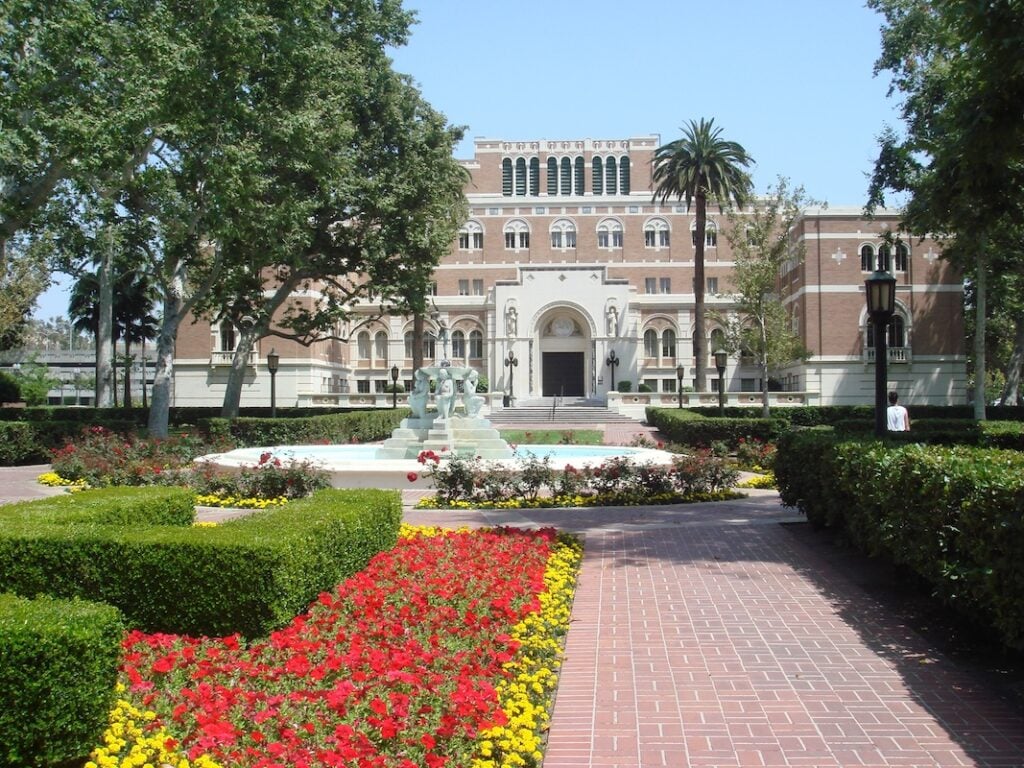
USC’s psychology program sits right in the heart of Los Angeles. The department brings together world-renowned scholars and one of America’s most diverse student groups. This combination creates an exciting environment where new discoveries happen every day.
The psychology department at Dornsife College of Letters, Arts and Sciences offers comprehensive psychology education through five specialized areas:
- Brain and Cognitive Science: Focuses on understanding cognition, motivation, decision-making, and perception in relation to brain processes
- Clinical Science: Applies scientific theories to understand adaptive and maladaptive functioning, with specializations in clinical-aging, child-family clinical, and adult clinical
- Developmental Psychology: Studies how social behavior, cognition, and emotions change throughout life
- Quantitative Methods and Computational Psychology: Looks at advanced research methods and statistical analysis
- Social Psychology: Examines how people’s thoughts and feelings change through group interactions
Research opportunities make USC’s psychology program special. Students can work on research projects or become research assistants at prestigious centers like the Brain and Creativity Institute and the Center for Economic and Social Research.
The program gives students amazing flexibility to explore interests beyond psychology, such as medicine, law, and business. Each major program provides both broad knowledge and specialized expertise that helps graduates succeed in advanced studies.
Graduate students can choose between master’s and doctoral paths. The department offers an MS in Applied Psychology, an MS in Applied Behavior Analysis, and five PhD programs matching the main study areas. USC leads in specialized training with unique features like the clinical geropsychology major, one of the first such programs nationwide.
USC’s strong alumni network and Career Center help students find great internships at mental health clinics, hospitals, research institutes, and nonprofits. These hands-on experiences build important connections in the field while strengthening professional skills.
Many students choose to pursue minors or double majors across different schools. This approach creates a well-rounded education that prepares them for today’s complex psychological practice.
School info
The University of Southern California Department of Psychology is a leading institution for psychological education and research. The department sits within the Dana and David Dornsife College of Letters, Arts and Sciences, where academic excellence meets real-life applications in a diverse setting.
Internationally recognized scholars lead groundbreaking studies at USC’s psychology department. These experts tackle both theoretical questions and society’s urgent needs. Their scholarly excellence shows in the rankings. U.S. News & World Report’s 2025 assessment places USC among the top doctorate psychology programs in the United States.
The student body’s makeup showcases USC’s dedication to diversity. Recent statistics reveal that women earned 77% of bachelor’s degrees in psychology, while men earned 23%. The graduates come from varied backgrounds: 32% White, 26% Hispanic or Latino, 16% Asian, 9% Black or African American, and 17% represent other backgrounds or international students.
Women earned 82% of master’s degrees. The department awarded 183 bachelor’s degrees, 127 master’s degrees, and 9 doctoral degrees in the 2021-2022 academic year.
This mix of backgrounds creates a perfect setting for cross-cultural research and learning. The department’s reliable infrastructure supports this mission through specialized facilities like:
- The Brain and Creativity Institute
- The Center for Economic and Social Research
- The Social Behavior Lab (12 years old)
USC provides great support resources for students. First-generation college students make up 23% of USC’s undergraduate population. The university helps these students through Student Equity and Inclusion Programs and offers financial aid via Continuing Student Scholarships and Scholarship Universe.
The psychology department focuses on five key areas: Brain & Cognitive Science, Clinical Science, Developmental Psychology, Quantitative Methods and Computational Psychology, and Social Psychology. Students can specialize while gaining broad knowledge of psychological principles.
USC’s psychology program gives students much more than classroom learning. Research assistant positions, independent projects, and internships at mental health clinics, hospitals, and research institutes give students hands-on experience.
Students who want clinical training can work at the on-campus clinic. First-year students perform cognitive, personality, and behavioral assessments here. This hands-on practice enhances their classroom learning.
Programs offered
USC’s Department of Psychology has academic programs from undergraduate to doctoral levels. These programs give students a perfect mix of theory and hands-on experience that prepares them for their future careers.
Students can choose from three distinct majors at the undergraduate level:
- A. in Psychology – A flexible program that lets students explore different academic and career interests
- A. in Cognitive Science – A program that smoothly combines psychology with neuroscience and computer science
- A. in Social Sciences with Psychology Emphasis – A major that connects psychology with broader social science concepts
The Psychology BA program has required courses in statistics and research methods. Students also learn about cognitive, developmental, clinical, biological, and social psychology. This well-laid-out structure helps graduates build both wide knowledge and deep expertise in psychological science.
USC also shines with its graduate programs. The department’s master’s programs include:
The Master of Science in Applied Psychology (MAPP) – Students can choose between on-campus and online formats. This creative program teaches psychology where theory, research, and business meet. MAPP brings together organizational and consumer psychology, which helps graduates build careers in user experience research, consumer insights, and organizational development.
The Master of Science in Applied Behavior Analysis – This program helps students build careers in ABA. It focuses on making life better if you have autism or other developmental disorders.
The department offers PhD programs in five specialized areas:
- Brain & Cognitive Science – Students tackle fundamental brain-mind questions
- Clinical Science – Students can focus on clinical-aging, child/family clinical, or adult clinical
- Developmental Psychology – Students study how people change throughout their lives
- Quantitative Methods and Computational Psychology – Students learn advanced research methods
- Social Psychology – Students learn how people and groups influence each other
Doctoral students must complete 36 psychology units in their first three years, plus specific research work. Clinical psychology PhD students also need to finish a full year of internship at an approved facility.
USC psychology programs stand out because they blend serious research with real-world applications. This approach helps graduates succeed in psychology and related fields.
Online options
USC provides flexible online learning options that match the academic standards of their campus programs. These options help professionals advance their psychology education without moving. One of their essential digital programs is the Online Master of Science in Applied Psychology (MAPP) program. It expertly combines consumer and organizational psychology.
Working professionals benefit from this specialized online program. Its project-based curriculum emphasizes real-life applications instead of pure theory. Students prepare themselves for careers in marketing, human resources, user experience research, customer experience research, and other people-focused business roles.
USC’s psychology program stands out because of its exceptional hands-on learning chances. Students can join optional international programs like the renowned internship in Dublin (often called the “Silicon Valley of Europe”). Global immersion trips help students see through new social and cultural viewpoints.
The curriculum structure gives students amazing flexibility:
- Complete the degree in as few as 16 months
- Balance academics with professional and family responsibilities
- Immediately apply classroom learning to workplace scenarios
Some courses in the online program need students and instructors to log in at the same time. Others let students complete activities when it suits them best. Students engage through group discussions, course videos, and interactive practice activities.
MAPP students must finish an internship or professional development program lasting one semester. They need to log 240 hours in a role that matches their career goals. This internship should be different from their current job and can be in any industry related to applied psychology.
USC gives online students access to detailed resources. These include virtual reference services, librarian consultations, electronic course reserves, research guides, interlibrary loans, and USC’s extensive electronic database collection.
Accreditation
The USC psychology program’s reputation rests on quality assurance through external validation. The Western Association of Schools and Colleges, Senior College and University Commission (WSCUC) has granted full institutional accreditation to the University of Southern California since March 6, 1949. USC meets strict standards in academic quality, institutional effectiveness, and student success.
The clinical psychology program’s specialized accreditation stands among the oldest in the field. The program managed to keep continuous accreditation from the American Psychological Association (APA) since 1948. This showcases nearly eight decades of recognized excellence. A full ten-year renewal came in 2018, with the next APA site review set for 2027.
USC’s steadfast dedication to scientific rigor brought additional prestige in 2010. The clinical psychology program became one of just ten programs nationwide that received accreditation from the Psychological Clinical Science Accreditation System (PCSAS). This elite status was renewed in 2021 for another decade. The renewal highlights the program’s exceptional science-centered education and training.
PCSAS accreditation makes a vital difference that helps prospective students, mental health consumers, and policymakers. Graduates receive high-quality, science-oriented education to advance public health and create new knowledge bases for mental and behavioral healthcare.
All the same, the department states that while APA accreditation runs through 2027, they will assess future decisions about dual accreditation based on program goals. Students should know that by graduation, the program might run exclusively under PCSAS accreditation.
Without doubt, these strict accreditations show USC’s commitment to exceptional educational standards. The program prepares students to make meaningful contributions to psychological science and practice.
Admission Requirements
The USC psychology program’s admission process needs detailed planning. Students can apply to the psychology PhD program only in fall semester. The application window opens September 1st.
The program has two main deadlines. Most students must apply by December 1st. Clinical science students have a priority deadline of November 10th. The system shuts down at 11:59 PM Pacific Time on deadline day. The program does not accept late applications.
Your application needs specific items. Write a personal statement about your psychology interests and how your experiences shaped your growth. Include details about your hands-on psychology work and your career goals for the next ten years. The statement has no page limit, but keep it focused.
You need three recommendation letters from professors or supervisors who know your graduate work potential. These letters must reach through the application system by the deadline. The letters serve as vital proof of your abilities.
Upload scanned copies of all your transcripts to the application portal. You might need to send official transcripts if selected for an interview.
The program does not need or review GRE scores. International students must submit TOEFL or IELTS scores unless they qualify for exemption.
Your application must include:
- A current resume/CV
- Names of 1-3 faculty members whose research matches your interests
- A $105 application fee
Strong candidates show excellent academic records, relevant experience, and leadership skills. They also express clear interest in the program through their statement of purpose.
Tuition
USC’s psychology program shows substantial differences in financial investment between undergraduate and graduate levels. PhD psychology program students receive strong financial support. Their package provides a $41,200 annual stipend, covers 36 tuition units yearly, and gives them detailed year-round health and dental insurance.
Students get a two-year fellowship in their graduate support package to focus on coursework. Three additional years of teaching or research assistant funding help them build professional skills. Students must take classes directly related to their degree and research while receiving 12 tuition units each semester.
Standard graduate rates apply to other psychology programs at USC. Students pay $36,630 when taking 15-18 units per semester. Graduate courses cost $2,467 per unit.
Students can use USC’s interest-free installment plans to pay their tuition throughout the term. The typical plan needs a down payment and four monthly installments each term from August to December or January to May. Students must renew this plan every semester, but summer terms do not have this option.
Additional Information
USC’s psychology program features enriching extracurricular activities that boost your educational journey. Psychology majors can join Psi Chi, a prominent honor society established in 1929 that promotes academic excellence. Students need a 3.3 overall GPA, second-semester sophomore status, and three completed psychology courses at USC to qualify for this prestigious organization.
USC’s commitment extends to providing complete support across its diverse student community. The university’s Student Equity and Inclusion Programs focus on intersectionality, sense of belonging, and well-being, which particularly benefits the 23% of USC undergraduates who are first-generation college students.
The psychology department’s study abroad options are a great way to get international experience. Many students choose The Chinese University of Hong Kong as their preferred destination to study psychology abroad.
Career preparation includes many internship possibilities in clinical, research, and business environments. Students have successfully interned at various organizations including:
- Ronald McDonald House
- Aviva Family and Children’s Services
- Institute for Creative Technologies
These extracurricular opportunities combine with USC’s strong academic foundation to create a well-laid-out educational experience that prepares students for various career paths in psychology.