
UC Davis Psychology Programs
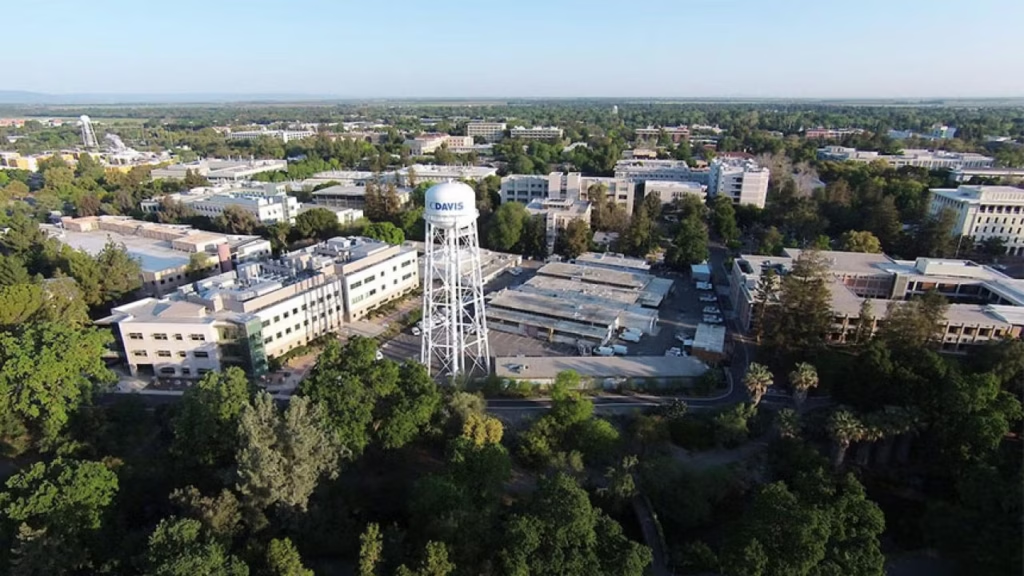
UC Davis Psychology Department ranks #6 among public institutions and #14 overall in the 2025 U.S. News & World Report graduate school rankings. This puts it among the top 2% of psychology Ph.D. programs nationwide. The department’s excellence in psychological science and education shows in these rankings.
The department sits in 167 Young Hall and studies both social and scientific foundations of behavior. UC Davis brings together leading researchers who study humans, animals, and computer models. Their work ranges from neurons to relationships to cultures as they try to understand how and why we behave the way we do.
Five major areas build the department’s intellectual foundation:
- Developmental Psychology: Studies changes in behavioral, cognitive, emotional, and social abilities throughout the lifespan
- Perception, Cognition, and Cognitive Neuroscience: Studies awareness and thought, including perception, learning, memory, language, and cognition
- Biological Psychology: Covers evolutionary, neurobiological, and molecular mechanisms of behavior
- Social-Personality Psychology: Looks at people in their social environment, including personality differences, emotions, stereotyping, and psychological health
- Quantitative Psychology: Works with statistical methods and research design
The program stands out because of its interdisciplinary approach. Students can move freely between these five core areas and take seminars in any specialty. This flexibility helps students develop fresh approaches to psychological research with broader points of view.
Students and faculty work in an informal and supportive environment. Mentorship thrives here as faculty and students work together on research projects. Undergraduates can work directly with faculty through various research projects and labs.
Graduate programs prepare qualified students for careers in research and teaching. But UC Davis doesn’t offer clinical or counseling psychology at the graduate level. The focus stays on advancing psychological science through research.
The undergraduate psychology program gives students a solid foundation in individual and group behavior. It provides a liberal arts curriculum that prepares students for jobs in business, government, and other fields right after graduation. Many students also go on to graduate studies in psychology, leading to careers in teaching, research, and applied work.
UC Davis has ranked among the top 10 public universities nationally for five straight years. This shows the university’s academic excellence and supportive learning environment.
Programs offered
UC Davis’s Department of Psychology provides students with multiple academic paths that match their interests and career goals. Students can choose between a Bachelor of Arts (A.B.) or a Bachelor of Science (B.S.) degree at the undergraduate level. Students interested in liberal arts typically choose the A.B. program, while those passionate about biology or mathematics gravitate toward the B.S. program.
Core courses in both programs give students a complete introduction to modern psychology. Students can also explore electives in Educational Psychology, Interpersonal Communication, and Psychological Anthropology. The department gets undergraduates involved in faculty research projects and internships to boost their practical experience.
The department runs a top-ranked Ph.D. program that prepares students for research and teaching careers. The program doesn’t offer training in clinical or counseling psychology. Students can earn a Master of Arts degree only as they progress toward their Ph.D., not as a standalone option.
Research starts right away in the Ph.D. program, with minimal required coursework. New students take Psychology 200 to learn about faculty research interests and activities. They then pick an Individual Advising Committee in their second quarter that guides them through their coursework, reading, and research requirements.
Students must complete graduate seminars, statistics courses, a written preliminary examination, pre-dissertation research project, oral qualifying examination, and dissertation to earn their doctorate. On top of that, advanced students can develop teaching skills through a two-quarter course about preparing materials, organizing courses, and teaching introductory psychology.
UC Davis psychology programs stand out because of their interdisciplinary nature. The programs cover five core areas: Developmental; Perception, Cognition, and Cognitive Neuroscience; Biological; Social-Personality; and Quantitative. Yet the boundaries between these specializations remain flexible by design. This approach promotes collaboration beyond traditional limits, and students take seminars in all five areas.
Students get unmatched intellectual and research opportunities through faculty connections with campus institutes and programs. These include the California Regional Primate Research Center, UC Davis M.I.N.D. Institute, Center for Mind and Brain, and Center for Neuroscience. This network helps students create innovative approaches to psychological research while working with leading experts in their field.
Online options
UC Davis takes a targeted approach to online education with its virtual learning options for psychology students. The psychology bachelor’s degree program at UC Davis does not offer an online option. The department focuses on giving students extra resources and tools to make their learning experience better.
Psychology students at UC Davis can access several specialized digital platforms. The university’s library subscribes to Psychotherapy.net, which streams training videos about psychotherapy, counseling, and social work. Students can watch interviews with expert psychotherapists, clinical demonstrations, live sessions, and detailed commentaries. The Psychology and Counseling collection from Alexander Street is also available with select videos about counseling, therapy, psychology, and social work.
UC Davis Continuing and Professional Education goes beyond psychology resources with its award-winning online programs. Students can learn at their own pace with just a computer and internet connection. These programs use innovative educational technology that combines video, interactive exercises, and online discussions with teachers and other students.
UC Davis supports all students who learn remotely. Many jobs today need virtual collaboration skills, so remote learning helps prepare students for their future careers. The university helps students succeed online by teaching effective strategies like retrieval practice, interleaving, spaced learning, and explanatory questioning.
Students also get access to PsychiatryOnline, which has DSM-5, clinical cases, handbook of differential diagnosis, and The American Journal of Psychiatry. This platform’s advanced search tools help psychology students find information quickly.
UC Davis gives psychology students quality online learning resources to supplement their campus-based degree programs through these different platforms and tools.
Accreditation
UC Davis psychology programs showcase their excellence through prestigious accreditations and professional organization memberships. The university has managed to keep full accreditation by the WASC Senior College and University Commission (WSCUC) since 1954. A comprehensive self-study process led to successful reaffirmation of this accreditation in February 2025, which involved campus-wide reflection on educational effectiveness. This accreditation confirms UC Davis’s high standards and allows students to access federal financial aid.
The psychology training programs at UC Davis have earned specialized recognition. The UC Davis MIND Institute Clinical Psychology Training Program’s Doctoral Internship received APA accreditation on contingency starting May 8, 2024. The program will seek full accreditation after collecting two years of outcome data from doctoral interns.
The UC Davis Clinical Child and Adolescent Psychology (CCAP) Doctoral Internship Program holds full American Psychological Association accreditation. The program team now prepares for their next APA review in 2025.
Both doctoral programs are part of the Association of Psychology Postdoctoral and Internship Centers (APPIC). The MIND Institute joined APPIC on April 20, 2022 with Member Number 2556. The Clinical Child and Adolescent Psychology program has been an APPIC member for many years.
Undergraduate students can join the psychology department’s Psi Chi Honor Society, which affiliates with both the American Psychological Association and American Psychological Society. Psi Chi membership benefits students because the United States government counts it toward GS-7 level requirements in Federal Service.
These accreditations demonstrate UC Davis psychology programs’ steadfast dedication to academic excellence and student success. External validation from accrediting bodies assures students that their education meets professional standards in psychological science and practice.
Admission Requirements
UC Davis psychology programs have specific admission criteria at both undergraduate and graduate levels. The psychology department has made a significant change to its graduate Ph.D. program: GRE scores are no longer required or accepted. This change aligns with most UC Davis graduate programs that have eliminated GRE requirements for 2026-27 admissions.
The application process works on a tiered deadline system that accepts applications until June 1, 2026. Students who submit by the priority deadline get first consideration and become eligible for internal fellowships. Graduate Studies distributes approximately $6.60 million in fellowships each year.
Transfer students looking to major in undergraduate psychology must complete several prerequisite courses. These include Psychology (PSY) 001, Statistics (STA) 013, Biological Science (BIS) 002A or Biological Science (BIS) 010. Students also need one additional course from Anthropology (ANT) 001, Molecular and Cellular Biology (MCB) 010, or Neurobiology, Physiology and Behavior (NPB) 010. A 2.90 GPA must be maintained across these courses.
Graduate applicants need an undergraduate GPA of 3.0 or higher on a 4.0 scale. Current UC Davis students can declare psychology as their major after completing PSC 001 and PSC 041 with a combined GPA of at least 2.5.
Application components for graduate programs include:
- Three letters of recommendation (at least one from someone with an academic title)
- Personal statement and statement of purpose
- Curriculum vitae
- Application fee: $135.00 for domestic applicants and $155.00 for international applicants
Students whose native language isn’t English must prove their proficiency through TOEFL or IELTS examinations.
Students in other majors have another path to psychology. They can switch majors by earning a 2.0 GPA in at least three upper-division Psychology courses if they don’t achieve a 2.5 GPA in PSC 001 and PSC 041.
Domestic applicants who participated in approved Graduate Preparatory Programs can receive application fee waivers. Some graduate programs also provide application fee fellowships to applicants with financial need.
Tuition
A UC Davis psychology education’s cost reflects its status as a leading research university. The 2025-26 academic year sets undergraduate tuition and fees at $16,474 for California residents and $50,324 for out-of-state students. These amounts show the “sticker price” that covers both tuition and fees, and this is a big deal as it means that the cost exceeds the national average in-state tuition of $12,422.
UC Davis’s Tuition Stability Plan keeps systemwide tuition and fees steady for up to six years after a student’s first term. Students and families can plan better since these fees make up a significant part of total costs. The plan doesn’t include campus-based fees of $2,247.37 or other expenses such as housing.
The Psychology Department’s graduate education comes with strong financial backing. Graduate students get guaranteed full funding for five years through Teaching Assistantships, Graduate Student Researcher positions, and Fellowships. This detailed funding package covers full tuition remission, non-resident supplemental tuition, and student health insurance.
UC Davis students can access various tuition assistance programs like UC Blue and Gold, Middle Class Scholarship, and the Native American Opportunity Plan. The university provides more than $7 million in scholarships that help students from a variety of backgrounds, with awards between $100 and $15,000 each academic year.
Your family’s income determines the actual cost you’ll pay. Net pricing ranges from $9,089 for families earning $0-$30,000 yearly to $31,575 for those earning above $110,000. Students must have health insurance, and UC Davis automatically enrolls them in the UC Student Health Insurance Plan at $2,841 unless they show proof of similar coverage.
International students pay an extra quarterly fee of $121 for administrative support. New students also pay a one-time document fee of $150.
Additional Information
UC Davis psychology students have access to excellent research facilities that boost their learning experience beyond traditional classroom education. They can work in specialized labs focused on human memory, social development, electrophysiology, and visual neurophysiology. Research assistant positions are available in faculty labs at various campus locations including the Center for Mind and Brain, the UC Davis MIND Institute, and the California National Primate Research Center.
The Undergraduate Psychology Association (UPA) welcomes psychology majors to join their community. Members connect with like-minded students, build professional networks, and participate in rewarding volunteer work. Students can join with a modest $15.00 annual fee. High-achieving students can also join Psi Chi, the International Honor Society in Psychology. This prestigious organization provides membership certificates and professional references to help advance students’ careers.
Graduates find rewarding careers in counseling, psychotherapy, psychiatry, applied behavior analysis, speech-language pathology, education, and human resources. Many alumni now work at leading companies such as Tesla, Microsoft, Credit Karma, and UC Davis Health.
Students can learn about potential careers through the department’s online databases. The MIND Institute’s APA-accredited doctoral internship program helps aspiring clinical psychologists become skilled at evidence-based assessment and intervention practices while maintaining high ethical standards.