
CSU San Marcos Psychology Programs
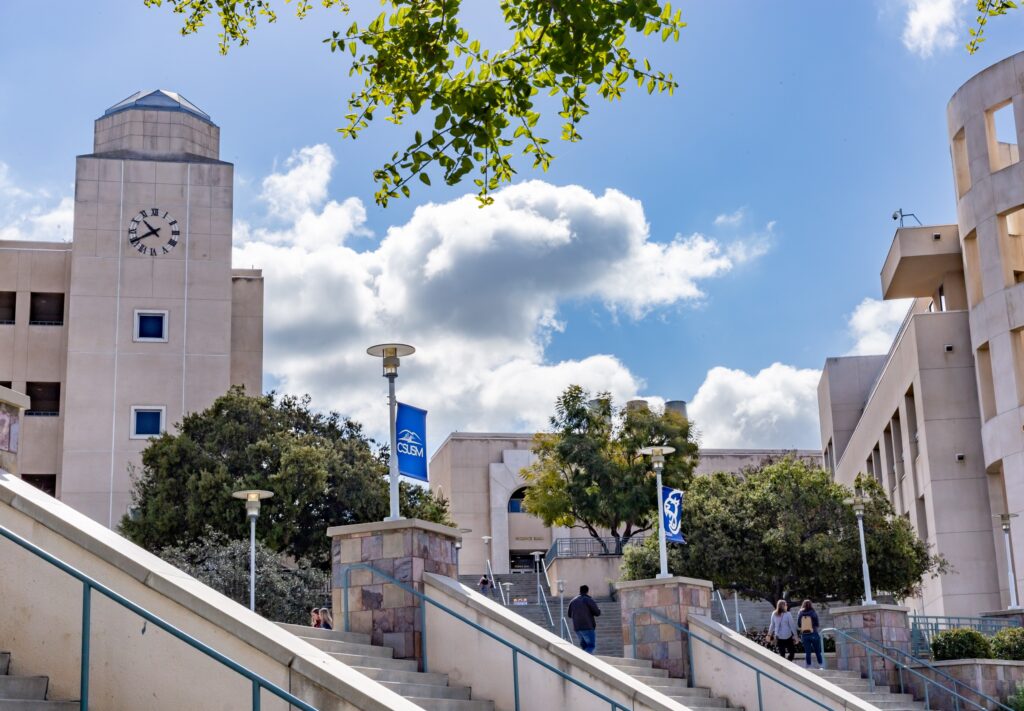
California State University San Marcos is a public institution with 16,255 students. The university ranks #63 in California and #950 nationally for its psychology programs.
More than 2,000 students learn through CSU San Marcos’s detailed psychology programs. The department thrives as a community where scholars and students head over to learn about behavior in humans and animals through scientific methods. Students and faculty break down biological, cognitive, and psychosocial influences to learn about human behavior.
CSU San Marcos Psychology’s strength lies in its scientific approach and skill development. Students become skilled at written and oral communication, research methods, and critical analysis. The curriculum includes multicultural viewpoints and ethical considerations.
The university follows a teacher-scholar model where tenure-line faculty teach three courses per semester. This model creates a balance between teaching and active research. Students learn from mentors who are both teachers and practicing scientists. The institution has 394 full-time instructional faculty members (45%) and 482 part-time faculty (55%).
Research labs are plentiful in the department. Most tenure-line faculty run active research labs that focus on specific topics like romantic relationships, stress, and autism. Students who work as Research Assistants (RAs) get great hands-on experience that improves their academic knowledge and career prospects. They can earn Psychology 499 credit while they develop research ideas, collect and analyze data, and prepare manuscripts.
Student success rates at the institution are impressive. First-year students return at a rate of 79% to start their second year, which beats the California average of 72%. The overall graduation rate reaches 59%, and 4% of students transfer to other institutions.
CSU San Marcos has earned its place as a Hispanic Serving Institution (HSI). The Collaborative on Academic Careers in Higher Education named it among the top 32 colleges most friendly to junior faculty. The university shows its steadfast dedication as an Affirmative Action/Equal Opportunity Employer by promoting diversity across campus.
The admissions process welcomes new students with a 93% acceptance rate from 13,986 applicants in fall 2021. However, only 18% of accepted students ended up enrolling. This selective enrollment will give a quality education with individual-specific instruction.
Programs offered
CSU San Marcos’s Psychology Department runs complete degree programs that help students build careers in psychological science and related fields.
The Bachelor of Arts in Psychological Science program gives students a solid foundation in major psychological fields and research methods. Students learn psychology as an empirical science and develop key skills in written and oral communication, information literacy, quantitative and qualitative research methods. They also learn to analyze complex problems critically. Research plays a central role in the curriculum. Students must take at least two research methods courses where they conduct studies and write research papers.
Students who complete this bachelor’s program master five core skills:
- Describing major concepts, theories, and empirical findings in psychology
- Applying scientific research methods in psychology
- Using creative and critical thinking to address psychological issues
- Independently evaluating scholarly literature
- Looking at different viewpoints and sociocultural perspectives
The Master of Arts in Psychological Science program delivers top-quality graduate education. This research-heavy program works well for students with different goals. Some want to pursue doctoral studies while others aim for community college teaching or research organizations. The program focuses on intensive research training and advanced coursework in key content areas.
The MA program helps students launch careers in research and teaching at community colleges. Many graduates head over to doctoral programs. A new graduate program in Clinical/Counseling Psychology will start in Fall 2026. This program will help students get licensed as Professional Clinical Counselors (LPCC).
Both programs open doors to many career paths. Psychology science majors find work in research labs, mental health agencies, hospitals, academic institutions, businesses, and public organizations. Graduates gain practical skills that make them valuable assets in mental health, education, business, marketing, and public policy.
Faculty members specialize in diverse research areas. These include psychopharmacology, recovery from major surgery, computer literacy in children, neuropsychology of hemispheric differences, and conservation psychology. Students get great opportunities to work with research mentors in these fields.
The programs don’t offer specific training for Marriage and Family Therapy (MFT) licensure or Board Certified Behavior Analyst (BCBA) certification. However, they are the foundations for students who want to pursue these specializations through doctoral programs.
Online options
CSU San Marcos mainly focuses on in-person psychology programs but also provides online learning options that complement traditional education paths.
The 2019-2020 academic year marked a huge shift in online learning at CSU San Marcos. Students embraced virtual education, with 16,353 (99.91% of the student population) taking at least one online class. Almost all of these students – 98.88% (16,183) – took their courses completely online. This shows remarkable growth since 2015-2016 when only 2,824 students took online classes.
Students can access high-quality online and hybrid education through Cal State Online. This system-wide platform allows students to pursue bachelor’s, master’s, and doctoral degrees without location or scheduling barriers. Current CSU San Marcos students can also take online courses from other CSU campuses.
CSUSM Extended Learning works with Cengage Learning/Ed2Go to offer many fully online, asynchronous courses that help with professional development and additional education. Students can start these flexible classes monthly and complete coursework at their own pace. They can choose between instructor-led or self-paced tutorials. Note that these courses don’t transfer toward degree programs.
CSUSM Extended Learning has several online degree options, though psychology degrees aren’t available in fully online formats yet. The online bachelor’s and master’s programs include:
- Criminology and Justice Studies (BA)
- Cybersecurity (BS/MS)
- Educational Administration (MA)
- Organizational Leadership (BA)
- Public Health (MPH)
- Social Work (MSW)
Graduate psychology students showed strong online participation in 2019-2020. Most students – 99.47% (1,320) took at least one online class, while 97.21% (1,290) completed their courses exclusively online.
The university keeps adding more online programs, especially certificate programs and professional development courses. Psychology students can boost their career prospects through specialized training in information security, front-end web development, and paralegal studies. These programs help students develop technical skills and expand their professional qualifications.
Accreditation
Quality education depends on proper institutional validation. Accreditation status is a vital factor when you look at psychology programs. CSU San Marcos holds full accreditation from the Western Association of Schools and Colleges (WASC), the official accrediting body for institutions of higher learning in the western United States.
CSU San Marcos earned its WASC accreditation in 1993 and managed to keep this status ever since. The institution stands strong with “Accredited” status today. This reflects the commission’s finding that CSU San Marcos meets all required standards. The latest commission action took place on December 17, 2024, showing their steadfast dedication to educational excellence.
Psychology students should know the value of this regional accreditation. Your credits will transfer smoothly if you decide to pursue advanced degrees or switch schools. Regional accreditation also serves as the foundation you need for professional licensing eligibility after graduation—a vital point for psychology careers.
CSU San Marcos’s specialized programs have earned additional credentials. The university’s doctoral internship in Health Service Psychology received American Psychological Association (APA) accreditation in October 2018. Doctoral students find this specialized recognition valuable because APA accreditation confirms that curriculum, faculty qualifications, and practicum components meet professional standards.
WASC will conduct its next review cycle with an Offsite Review in Fall 2025, followed by an Accreditation Visit in Spring 2026. The APA-accredited doctoral internship program will have its next site visit in 2028.
CSU San Marcos’s 30-year-old accreditation history gives you confidence that your education meets quality and rigorous standards. This matters greatly for your future success in psychological practice.
Admission Requirements
CSU San Marcos Psychology programs admit students through a moderately selective process with an acceptance rate of 62%. Each academic level and background requires specific admission criteria.
Undergraduate freshmen hoping to join the Psychology program must graduate high school with a college preparatory study pattern. The pattern should cover 4 years of English, 3 years of mathematics, laboratory science, and social science. Students need a minimum 2.5 GPA on a 4.0 scale. The university’s eligibility index combines high school GPA with standardized test scores. Students with a 3.0 GPA or higher can skip submitting test scores.
Transfer students‘ admission criteria depend on their completed college credits. Students with fewer than 60 semester units must submit both high school and college transcripts. They need a 2.0 cumulative GPA and C- or better grades in English composition and mathematical concepts. Students with 60+ semester units follow similar requirements but only need to submit college transcripts.
The MA in Psychological Science program sets high academic standards. Students can apply between October 2025 and February 1, 2026 for Fall 2026 admission. A complete application package should have:
- Official transcripts from all colleges attended
- Three letters of recommendation (at least two from college professors)
- Personal statement describing goals, interests, and naming CSUSM faculty with whom you’d like to conduct research
- Optional GRE scores (no penalty for non-submission)
Graduate applicants should hold a bachelor’s degree in psychology or equivalent coursework. This includes statistics and four upper-division psychology courses with at least one lab course. Students must maintain a minimum 3.0 GPA both overall and in upper-division psychology courses.
International applicants must meet extra requirements. Undergraduate admission requires TOEFL scores of 61 (no writing score below 19) or IELTS scores of 5.5 (no section below 5.0). Graduate programs need higher scores: TOEFL (80+), IELTS (6.0+ writing, no section below 5.5), Duolingo (110+), or PTE (65+).
Psychology majors must complete all major courses with a C grade (2.0) or higher. CSUSM requires students to complete at least 18 units of their major coursework at the university.
Application deadlines vary by term. Transfer students can apply for Spring 2026 between August 1-September 30, 2025. Fall 2026 applications open from October 1-December 31, 2025.
Tuition
The cost of your psychology education at CSU San Marcos goes beyond basic tuition. Let’s break down what you can expect to pay in 2025-26 as an undergraduate psychology major.
California residents who study full-time (6.1+ units) pay $3,225 in tuition and $1,004 in mandatory campus fees each semester, which adds up to $4,229. Part-time students (0-6 units) pay $1,869 in tuition plus campus fees, totaling $2,873 per semester. Students from outside California need to pay an extra $444 per unit.
Graduate psychology students pay more. California residents enrolled full-time need to pay $4,032 in tuition and $1,004 in mandatory fees, reaching $5,036 per semester. Part-time graduate students pay $2,340 plus fees, which comes to $3,344. Non-resident graduates also pay an additional $444 per unit.
These mandatory campus fees are split across several areas:
- Academic Excellence & Student Success: $250
- Mental Health Fee: $105
- Student Union: $315
- Athletics: $100
- Health Services: $75
Your yearly expenses depend on where you live. Full-time undergraduate residents who live with their parents can expect to pay around $24,608 annually, while those living off-campus might pay up to $38,072. Graduate students face similar costs ranging from $24,636 to $38,114 per year.
Students from eligible Western states can save money through the Western Undergraduate Exchange program. This program lets you pay just 150% of resident tuition instead of full non-resident rates. Your tuition would be $4,563 per semester – a great way to cut costs.
The university offers payment plans with a $25 signup fee. Summer payments can be split into two or three installments based on your enrollment timing. The State University Grant helps eligible students cover tuition fees through need-based awards.
Some psychology courses have extra fees. PSYC 402, for example, has a $20 course fee. Make sure you check all possible fees before registering to avoid surprises during your psychology studies at CSU San Marcos.
Additional Information
CSU San Marcos Psychology provides great resources to improve your academic experience beyond the classroom. The Psychology Academic Resource Laboratory (PARL) helps students with quantitative skills, computing, writing, and research methodology—everything you need to succeed in psychological science. Students can access PARL’s services in person (SBSB 1206) or through Zoom when graduate assistants are available during posted hours.
Research opportunities at CSUSM keep growing. Tenure-line faculty members run active research labs that focus on specific topics like romantic relationships, stress, and autism. Your role as a Research Assistant will help you build skills in creating research ideas, collecting data, and preparing manuscripts.
Faculty members conduct research in a variety of areas including comparative psychology, cognitive psychology, developmental psychology, clinical psychology, social and cultural psychology.
Students can get extra help for challenging courses through NetTutor. CSUSM’s success stories include alumni like Ashley Emami who completed her MA in Psychology, earned her PhD in Clinical Psychology, and now serves as a Clinical Psychologist at the VA in San Diego.
The Career Center connects students with internship opportunities through various programs. Students can choose from credit internships, non-credit internships, or micro-internships based on their professional goals. A Psychology Affinity Network is under development to strengthen alumni connections.