
Chapman University Psychology Programs
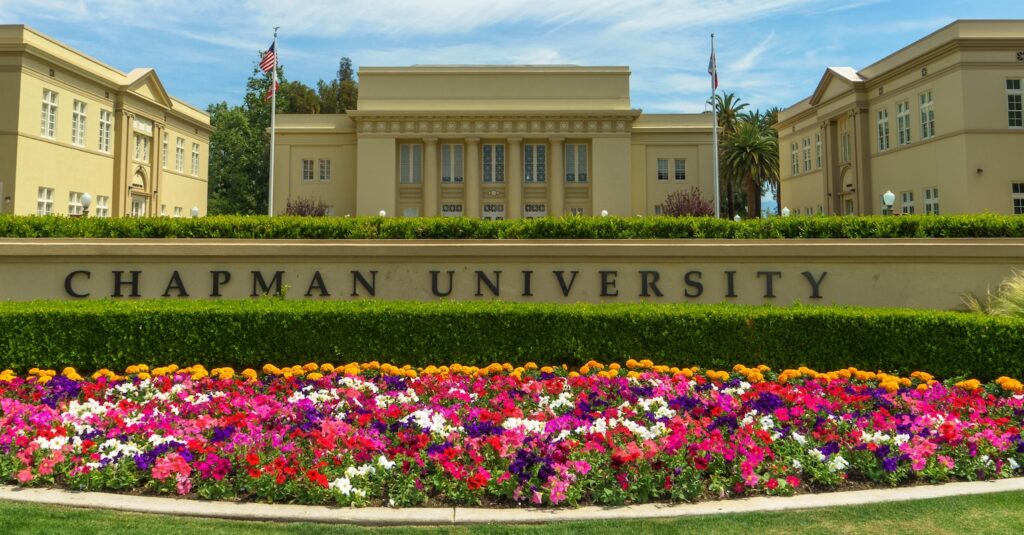
Founded in 1861, Chapman University is a 162-year-old private institution in Orange, California. The university’s 90-acre suburban campus offers students both academic excellence and tailored education.
Chapman University holds the #110 spot among National Universities and ranks #73 for Best Colleges for Veterans in U.S. News & World Report’s 2026 edition. Students benefit from a 12:1 student-faculty ratio that ensures plenty of one-on-one time with professors. The learning environment stays intimate since 40% of classes have fewer than 20 students.
The university has several colleges and schools, with its psychology programs located in the Crean College of Health and Behavioral Sciences. Psychology students work directly with faculty members who are well-known experts in their fields and stand out through their teaching, research, and creative work. Dr. Tara Gruenewald leads the Psychology Department, which has professors specializing in different areas of psychology.
Chapman’s psychology program stands at #250 nationally among graduate programs. The General Psychology major grew 18% in the 2021-2022 academic year, with 138 students earning their bachelor’s degrees.
Student numbers at Chapman break down to:
- 7,713 undergraduates
- 2,047 graduate students
- 9,760 total students
The student community shows diversity:
- 61% women
- 47% White students
- 20% Hispanic students
- 16% Asian students
Psychology students can access these campus resources:
- Student Psychological Counseling Services with individual counseling, groups, and workshops
- Research opportunities at places like the Center for Excellence in Biopsychosocial Approaches to Health
- Mutually beneficial alliances with medical centers like Children’s Hospital of Orange County
The university keeps growing stronger, with several graduate programs moving up in rankings over the last several years. Chapman has grown into a complete institution where psychology majors learn both theory and hands-on skills they’ll need for their future careers.
Programs offered
Chapman University’s BA in Psychology gives you a solid foundation in psychology as an empirical science of human behavior. The program works best for students who plan to pursue graduate studies or careers in human services. Students learn critical thinking, psychological research methods, and evidence-based approaches to understand human behavior.
Your academic experience at Chapman will help you develop skills to analyze data, think critically, and apply scientific methods when studying human cognition, emotion, and behavior. Core foundation courses build your understanding of psychological science. A senior thesis connects your goals with psychology’s present and future directions.
Psychology majors follow a well-laid-out four-year plan. The first year starts with basic concepts through Introduction to Psychology and Critical Thinking courses. Second-year students take Statistics for Behavioral Sciences and Research Methods. Third-year coursework includes specialized psychological processes and Physiological Psychology.
Chapman’s psychology program stands out because of its hands-on experience. Since it’s an undergraduate-only program, you work directly with faculty in research and fieldwork internships without competing with graduate students. Students can join faculty-led research at several facilities:
- The Center for Excellence in Biopsychosocial Approaches to Health
- Children’s Hospital of Orange County Research Institute
- Computational Analysis of Health Behavior Laboratory
- Early Human and Lifespan Development Program
Chapman offers many internship opportunities in schools, hospitals, and mental health settings. Students get practical experience before they graduate. The university encourages study abroad programs because understanding human cognition benefits from a global point of view.
Senior year students complete a capstone project by choosing one option: Individual Research, Senior Thesis, or Senior Seminar in Psychological Topics. This final project helps students connect their psychological knowledge and prepare for their next steps.
A psychology degree provides valuable skills that work in many industries. Many students continue their education with graduate degrees. Chapman graduates often pursue master’s degrees in clinical psychology, counseling psychology, marriage and family therapy, or social work. Some advance to doctoral programs (Ph.D. or Psy.D.) or medical school.
The psychology department has a chapter of Psi Chi, the National Honors Society in psychology. This organization actively supports curriculum development and educational effectiveness. Students join a vibrant community of peers who share their passion for psychological science and its applications.
Online options
Psychology majors at Chapman University need flexible learning options to balance their work, family, and academic commitments. The university has expanded its online course offerings to meet these student needs.
Chapman’s digital world transformed during the 2019-2020 academic year. The numbers tell an interesting story – 7,462 students took at least one online class, which made up 76.45% of the entire student body. About 695 students (7.12%) completed all their coursework online. This showed Chapman’s ability to deliver fully virtual education.
Online options give undergraduate psychology students the flexibility they need. The 2019-2020 data shows that 86.32% (6,242) of Chapman’s 7,231 undergraduate students took at least one online course. Additionally, 409 students (5.66%) earned their degrees through online classes exclusively.
Graduate psychology students embraced digital learning opportunities too. The numbers showed that 1,211 (51.38%) of 2,357 graduate students enrolled in at least one online class. A higher percentage of graduate students – 283 (12.01%) – studied entirely online. These numbers make sense because advanced students often need to balance their careers with academics.
Chapman’s online education growth tells a compelling story:
| Year | Students Taking At Least One Online Class |
| 2015-2016 | 32 |
| 2016-2017 | 48 |
| 2017-2018 | 52 |
| 2018-2019 | 32 |
| 2019-2020 | 7,462 |
This dramatic growth shows Chapman’s steadfast dedication to virtual learning. The change becomes even more striking when you consider that before 2019-2020, almost no students studied completely online. By 2020, that number jumped to nearly 700.
Chapman’s psychology majors now experience a mix of traditional and online learning. The psychology curriculum adapts to different learning styles without compromising academic standards. Online courses mirror their on-campus versions in content while offering more scheduling options.
Students access interactive materials, join virtual discussions, and complete assignments through Chapman’s online platform. This setup works great during internships or research projects when students need flexible schedules. Chapman’s investment in strong digital infrastructure creates an excellent online learning environment that enhances its classroom teaching.
Accreditation
Chapman University’s psychology degree quality comes with a solid backing. The university has managed to keep its accreditation from the Western Association of Schools and Colleges (WASC), Senior College and University Commission (WSCUC) since 1956. Students can access federal financial aid and other programs because of this accreditation.
Chapman completed its latest accreditation review through the Thematic Pathway for Reaffirmation (TPR) in June 2023. This optimized process only applies to schools that show “consistent evidence of healthy fiscal condition, strong student achievement indicators, and sustained quality performance”. The university’s next accreditation visit will happen in Spring 2033. They need to submit an Interim Report in Fall 2026 and go through an Offsite Review in Fall 2032.
Chapman’s psychology program thrives under the university’s broader accreditation structure. WSCUC accreditation will give psychology majors an education that meets strict standards through ongoing improvements and peer reviews. This status shows the university meets established benchmarks for academic quality, effectiveness, and student success.
Chapman’s psychology-related programs have earned specialized credentials:
- The Ed.S. in School Psychology program is fully accredited by the National Association of School Psychologists (NASP)
- The school psychology program also holds accreditation from the International School Psychology Association (ISPA)
- The marriage and family therapy program is accredited by the Commission on Accreditation for Marriage and Family Therapy Education
Chapman University has secured professional accreditations in disciplines of all types. The university holds accreditation from 15 different professional organizations. These include bodies relevant to psychology students seeking broader knowledge: the Council on Academic Accreditation in Audiology Speech-Language Pathology of the American Speech-Language-Hearing Association and the Council for the Accreditation of Educator Preparation.
WSCUC assigns each school a staff liaison who handles all accreditation activities. Chapman’s main Orange campus and the Harry and Diane Rinker Health Science Campus in Irvine both have active status.
Your psychology degree from Chapman meets rigorous standards set by respected external evaluators. This credibility will help improve your prospects when you apply to graduate schools or enter the job market.
Admission Requirements
Getting into Chapman’s psychology major needs you to understand both general university and program-specific requirements. Chapman differs from public universities as it doesn’t have a single set of requirements that guarantees admission to all majors.
Chapman welcomes transfer students from both two-year and four-year colleges. You can check how your existing college credits will transfer to Chapman’s psychology program through Transferology, a free online tool. This tool shows the latest articulation information that helps you plan your academic path effectively.
Chapman’s psychology program, like some other majors, has specific prerequisite courses you must complete before transferring. Note that these prerequisites can be in progress when you apply. Some prerequisite courses can serve dual purposes by meeting both general education requirements and major-specific needs.
Your psychology major application must include:
- Transfer Common Application with Chapman University Questions
- At least one transfer letter of recommendation
- Non-refundable $70 application fee
- Official college transcripts from all colleges attended
- Official high school transcripts (if you’ve completed fewer than 60 semester units)
All applicants must complete or be working on a transferable college-level math course, whatever their intended major. Some exceptions apply for certain AP/IB scores.
Key unit requirements include:
- 120 units minimum required for graduation
- 70 units maximum accepted from community college
- 48 units minimum must be completed at Chapman
International students face additional requirements, including proof of English proficiency if English isn’t their native language.
Most Chapman majors, including psychology, let you start in either fall or spring semesters. Students who have completed 60 or more college units when applying don’t need to submit their high school transcripts.
Chapman doesn’t list psychology-specific prerequisites separately. You should connect with the psychology department or admission counselors to ensure you’ve met all requirements for your preferred psychology concentration.
Tuition
Your psychology degree at Chapman University requires careful financial planning. The undergraduate tuition costs $64,580 for the 2024-2025 academic year. This amount will rise to $67,490 in 2025-2026. Chapman charges the same tuition to all students regardless of their state residency.
Students taking 12-18 credits per semester pay flat-rate tuition. The costs differ for part-time students who paid $1,940 per credit hour in 2022-2023. Summer sessions come with reduced rates – psychology students pay $970 per credit in summer 2024.
The total cost of your education has many more expenses:
- Books and supplies: Approximately $1,600 annually
- Health center fee: $122 per semester (mandatory)
- Associated student fee: $80 for full-time students
- Student health insurance: $2,005 annually (can be waived with proof of existing coverage)
Your expenses also depend on housing choices. Psychology students must live on campus for their first two years. The combined cost of on-campus housing and meal plans averages $17,378 yearly. Students can choose from various residence halls. Triple rooms cost $8,273 per semester while single rooms cost $10,504.
Chapman’s financial support makes education more achievable. The university gave out over $215 million in aid last year. This helped 85% of undergraduates. Students received an average aid package of $34,600. Merit scholarships can reach $42,000 per year. The best part? You don’t need separate applications – admission applications by the deadline automatically qualify you.
Psychology graduates leave with an average debt of $38,332. This amount seems reasonable given the career opportunities that come with a Chapman psychology degree. Veterans and their families with 100% GI Bill® eligibility usually get full tuition coverage through VA benefits, Yellow Ribbon contributions, and financial aid.
Chapman’s steadfast dedication to affordable education started in 1861. The university uses scholarships, fellowships, and need-based aid to help students from a variety of financial backgrounds join its psychology program.
Additional Information
Chapman University’s psychology graduates excel in a variety of career paths. The program’s ability to prepare students for their professional lives shines through numerous alumni success stories. CJ Tadros (’23) landed a Health and Wellness Coordinator role in a corporate HR department right after graduation. Christine Chang (’22) published her senior thesis on parental leave and maternal postpartum depression.
Psychology majors have abundant research opportunities at Chapman. Students gain hands-on experience as research assistants in facilities like the Healthy Aging Lab. Faculty members support undergraduates to present their original research at prominent conferences, including the Western Psychological Association. Students also actively participate in Chapman’s SURF program.
Students can earn 0.5 to 6 academic credits through internships, with each 0.5 credit requiring 20 hours of work. The degree program allows up to 12 credits from internship experiences.
Chapman’s psychology students engage in vibrant campus life through organizations like:
- Psi Chi Psychology Honor Society
- Over 175 recognized clubs spanning academic, professional, and special interest groups
Career services play a vital role in student success. Career Services Manager Heidi Girolamo helps students discover job opportunities shared by alumni. “My time at Chapman gave me the confidence to pursue further education”, says Ariann Ghorbanian (’18), demonstrating how the program empowers students to achieve graduate school and career goals.